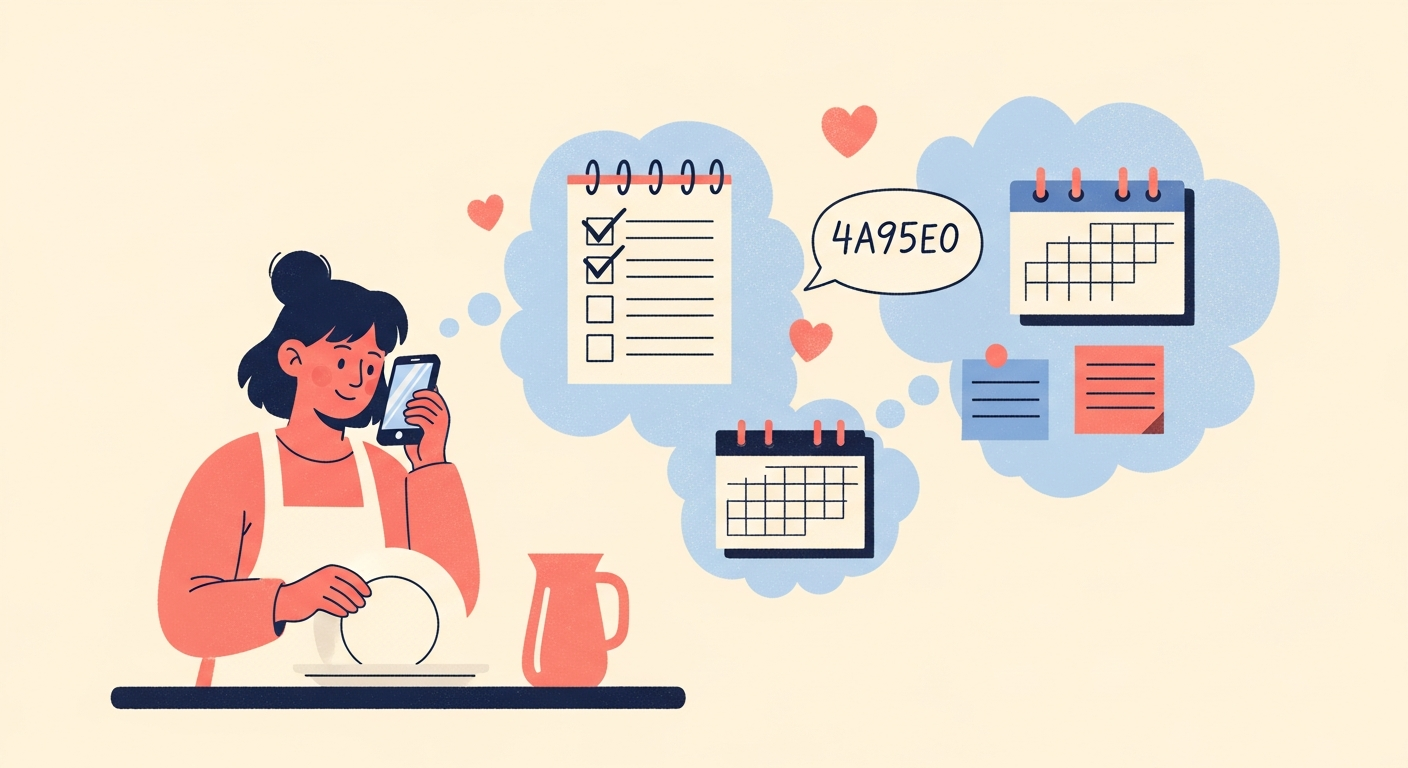
you're loading the dishwasher and a thought arrives fully formed: call the dentist, that idea for the client deck, mom's birthday is friday. by the time your hands are dry, two of the three are gone.
a second brain for ADHD only works if it catches the thought at that moment, not later when you "have time to organize," and if it hands the thought back weeks later when you can only half-describe it. most systems get both of those backwards.
the two jobs a second brain actually has
strip away the productivity-blog aesthetics and a second brain has exactly two jobs:
- catch the thought with zero friction, in whatever messy form it arrives
- give it back later, reliably, without you remembering where you put it
neither of those is "organize beautifully." organization is a means, not the goal. a well-organized system that nothing gets into isn't a second brain. it's an empty filing cabinet.
why Notion, notes apps and bullet journals become graveyards
open most people's default notes app and you'll find hundreds of entries. some untitled, some half a sentence, some in a folder called "misc" that was supposed to be temporary. Notion and Obsidian vaults go the same way, just with nicer fonts.
the failure point is the same in all of them. they ask for a sorting decision at capture time: is this a task or a note, which project, which tag, what due date. that decision takes executive function, and executive function is exactly what's in short supply in the moment a thought shows up.
so one of two things happens. the thought doesn't get captured at all, or it goes into a generic inbox that never gets processed. that isn't a discipline failure. it's a mismatch between what the system demands (sort now) and what your brain can supply right then (nothing, it's busy holding the thought together).
why manual sorting costs more with ADHD
here's the mechanism. capturing a thought and then deciding where it goes are two tasks stacked on top of each other. you were thinking about the idea. now you're thinking about the system. working memory has to hold both, plus whatever you were doing before the thought interrupted you.
research on ADHD and working memory describes that as a bottleneck, not a storage problem. you don't lack ideas. you lack room to hold one while you do three other things, like unlocking your phone, finding the right app and typing it out properly. every step between the thought and "safely stored" is a chance for it to fall out, or to get stored so carelessly that it's unfindable later.
and the system isn't a one-time setup cost. every new note has to be tagged correctly, or it decays back into the pile. PARA, color-coded folders, tag conventions, symbol legends: they work for the person who designed them. for everyone else, they're a recurring tax on the same limited attention that made capture hard to begin with.
the workarounds that quietly break
the usual fixes all look reasonable and all fail the same way.
- search bars. they work if you remember the exact word. weeks later you don't. you search "appointment," but you wrote "checkup," so nothing comes back.
- tag hierarchies. you have to invent a taxonomy, remember it, and apply it consistently under time pressure. most people manage a week.
- daily note dumps. these solve capture, sort of, and make retrieval worse. the thought you need is buried in a wall of text from three Tuesdays ago.
- "it's in there somewhere." works until the pile hits triple digits and everything looks equally plausible.
all of them assume you'll remember something specific enough to find the note: a word, a tag, a date. but the reason you needed a second brain is that you don't reliably remember things. asking you to remember the metadata is asking you to solve the same problem twice.
a second brain that files itself
the fix isn't a better folder system. it's removing the folder decision entirely, on both ends.
Enkily is built around one voice note. you talk, in whatever order the thoughts come out:
"okay, call the dentist tomorrow morning, the client wants the deck revised by friday, mom's birthday is this weekend, and i had an idea for the onboarding flow, make the first screen simpler."
from that one ramble Enkily pulls a reminder to call the dentist tomorrow, a reminder for the deck due Friday, a calendar event for mom's birthday, and the onboarding idea kept as a note, because it isn't a task. reminders land in Apple Reminders, events in Apple Calendar. you didn't sort any of it. you just talked.
a second brain you can ask
this is the part people forget, and it's where most "AI memory" tools are thinner than they sound.
Enkily keeps what you say as a private, searchable memory, and it searches by meaning. "what did I say about the dentist?" finds the capture where you said "checkup." Ask Enkily answers in a sentence and shows which capture the answer came from, so you can check it instead of taking its word. ask about something you never said, and it tells you it has nothing saved about that yet. it won't make something up.
the Memory tab also gathers the people, places and facts you've mentioned, so the name of your kid's teacher or the restaurant a friend recommended has a home even though you never filed it anywhere.
what an AI memory can't do
it can't remember what you never told it. it won't make a thought important to you. and it isn't a replacement for treatment or support if ADHD is getting in the way of your life. it's a place to put things that gives them back. that's a modest claim, and it's the useful one.
how to start without building a system
- pick one capture point and make it one gesture. put the Enkily widget on your Lock Screen, or set your Action Button to "Capture a Thought."
- capture messy on purpose. don't clean it up before you say it. the sorting is the app's job.
- ask before you search. when you need something, ask the question you'd ask a friend.
- don't migrate your old vault. start fresh. the old notes aren't going anywhere.
- AI for ADHD: what an assistant has to do to be worth trusting
- what a voice capture app for ADHD should actually do
- how to build an external working memory
Enkily is on the App Store for iPhone: free for 7 days, then $7.99 a month or $69 a year. a second brain for ADHD isn't a nicer notebook. it's the gap between having a thought and losing it closed down to nothing, plus a way to go back and ask what you already said.